

A Better Way is Here
Did you know Scripture contains hundreds of verses about leadership?
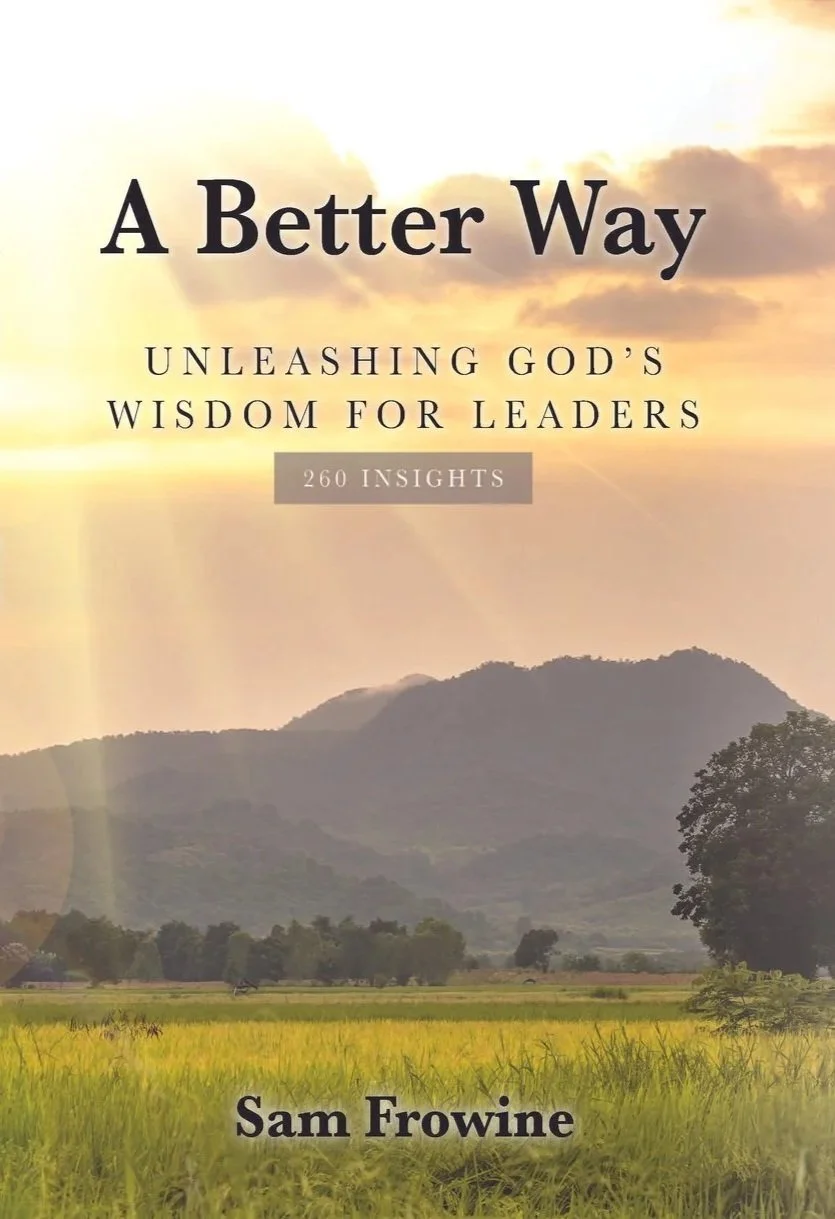
A Better Way brings many of these powerful truths together with practical insights from marketplace leader Sam Frowine.
In a world of constant change, leaders need more than the latest leadership theories—they need an anchor for the soul. While power, influence, and wealth come and go, God’s wisdom endures forever.
Whether you lead a company, a team, or are simply seeking purpose in your work, this book offers practical encouragement—from navigating real business challenges to pursuing a balanced life.
A Better Way invites leaders to integrate faith, wisdom, and leadership in every area of life.
Two economies run side by side, and leaders must choose one
Sam Frowine has spent decades in the marketplace, and the Scriptures collected here are the ones he marked in his Bibles and journals across more than thirty years of that work. A Better Way gathers them into 260 short entries, one for every workday of the year. Each entry sets down a handful of verses, a brief insight drawn from the realities of running an enterprise, and one question to carry into the day.
The premise is stated plainly in the opening pages. There is a usual way of leading, which puts profit and personal achievement ahead of everything else, but there is a better way. Frowine calls the leader who chooses the second path a Kingdom Builder: someone who places identity under God's authority, integrates Scripture into ordinary business decisions, and organizes resources to further God's work. The book exists to give that idea language and structure to that second path, so it can be followed rather than merely admired.
Fifty-two chapters move through eight sections, beginning with the secrets of God's economy and proceeding through enterprise building, leaders of purpose, character formation, the battles a Kingdom Builder faces, the journey itself, prosperity, and a hopeful future. Individual entries take up ownership and stewardship, calling and readiness, diligence and rest, discernment, ethics in agreements and in the treatment of people, conflict resolution, anxiety and confidence, partnerships and trusted advisors, money and generosity, succession, and what one generation of leaders owes the next. A topic index at the back lets a reader target topics that are top of mind.
Frowine writes as a business owner rather than a theologian, and the insights carry the texture of that vantage point: making payroll in a lean season, losing an important client, the over-confidence that follows too much growth too fast, the founder who cannot let go. He is candid about his own limits and need for faith. Entries are short and the language is direct. The tone is warm and never scolding.
The book is written for business owners, executives, emerging church and marketplace leaders, and family enterprise members. It suits daily devotional use, small group discussion, and mentoring relationships. Readers of Frowine's earlier books, among them Lifeblood, Foundations, Blueprint, and Becoming a Kingdom Builder, will recognize the same concern with true wealth, here traced back to its source in Scripture.